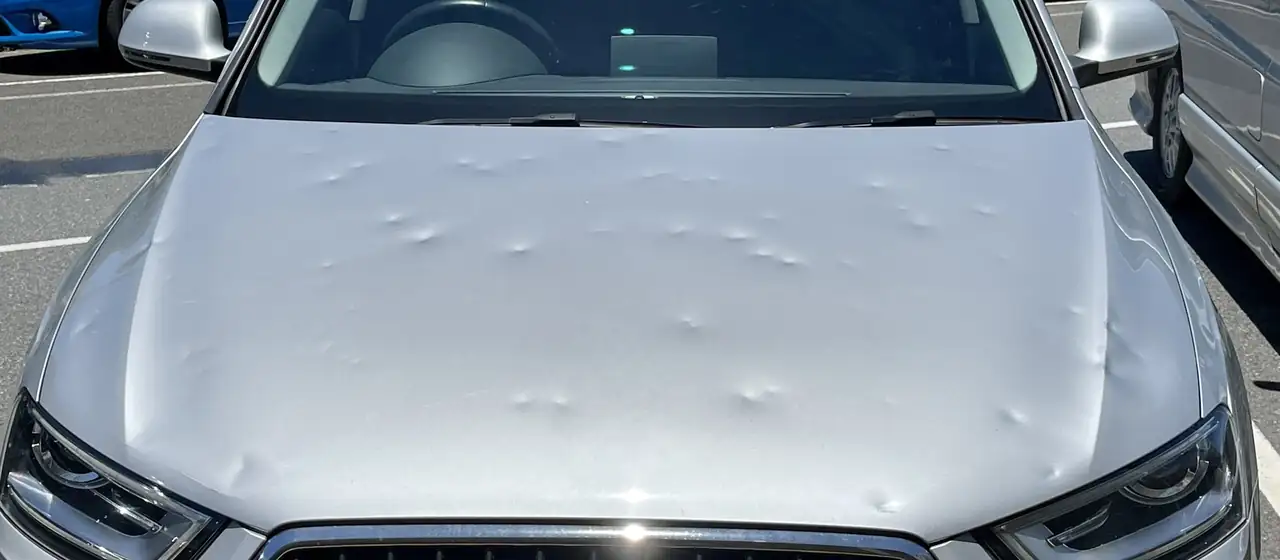
Colorado gets more hail claims than almost anywhere. What to do after a hailstorm, how insurance and paintless dent repair usually work, how to avoid storm-chaser scams, and what else to check on an import.
If you've lived on the Front Range for more than a summer, you've probably heard it: the sudden roar on the roof, and then a parking lot full of dimpled cars. Colorado is hail country. In a three-year look at insurance claims (2017–2019), the National Insurance Crime Bureau counted 380,066 hail loss claims in Colorado, second only to Texas, and Denver and Colorado Springs ranked second and third among US cities.
Right after the storm
- Take photos of every panel, the glass and the lights, in good light, from a few angles. Date-stamped photos make the claim easier.
- Check the glass. A cracked windshield is a safety problem, not just a cosmetic one. Sunroofs and rear glass can crack too.
- Look at the lights and mirrors. Cracked headlight and taillight lenses let water in.
- Call your insurance company or agent before you sign anything with anyone. Hail is usually covered under comprehensive, not collision, so check your policy and your deductible.
How hail repair usually works
Most hail dents are fixed with paintless dent repair (PDR): a technician works the dent out from behind the panel without repainting. Done well, it keeps the factory paint, which matters for resale. Panels with cracked paint, very large dents, or dents on sharp body lines may need conventional bodywork and paint instead.
Aluminum panels, which are common on hoods and other panels of many newer European cars, can be harder to repair this way. Expect the estimate to say which panels get PDR and which get replaced or painted.
Watch out for storm chasers
After a big storm, pop-up dent shops and door-knockers show up fast. The NICB's advice is simple: if you didn't ask for it, turn it down. They also suggest:
- Get more than one estimate
- Don't sign a contract on the spot
- Get everything in writing
- Ask for references and check them
- Write down the contractor's license plate and ask to see a driver's license
Check with your insurer first. Many have preferred repair shops, but in most cases you can choose where your car is repaired.
What else to check on an import
Hail mostly hits the top of the car, but while it's in a shop, it's worth a look at:
- Sensors and cameras. Front radar sensors, parking sensors and windshield-mounted cameras may need to be recalibrated after glass or bumper work. Ask the shop if your car needs it.
- Sunroof drains and seals. If the sunroof glass was damaged or replaced, make sure the drains are clear.
- Trim and moldings that may have cracked.
If it isn't worth fixing
Some older cars with heavy hail damage end up with insurance paying out instead of repairing. That can affect the title and resale value. Ask your insurer how they handle it before you decide, and if you're buying a used car in Colorado, look closely for hail dents in the roof and hood in low, raking light. They're easy to miss in a parking lot at noon. Our used-car buyer guides cover what else to check.
Sources
General information, not legal advice. Check CDOT and your owner's manual for the rules and specs that apply to you.